Every vehicle in Monongalia County is being logged.

The Monongalia County Sheriff's Office runs 20 Flock Safety automated license plate readers. In the last 30 days they logged 429,254 unique vehicles, roughly four times the county's population.[2] The program was paid for with $180,000 of opioid settlement money, approved outside the county's own grant process.[1]

20cameras on county roads
429,254unique vehicles logged in 30 days (as of Sept 2026)
$180,000of opioid settlement funds, over 3 years
21 daysclaimed data retention

What is Flock?

Flock Safety is a private company that sells what it calls "surveillance as a service." Its automated license plate readers (ALPRs) are cameras mounted along public roads. Each time a vehicle passes, the camera photographs it and uploads the image to Flock's servers, where software reads the license plate and records the vehicle's make, model, color, and other details, along with the time, date, and location of the sighting.

Each sighting becomes a record in a national database that Flock's customers (police departments, sheriff's offices, and other agencies across the country) can search. A single query can return everywhere a vehicle has been seen on the network, not just in Monongalia County.

The Sheriff's Office credits the system with real investigative results, including recovering a child in an abduction case in August 2026.[2] Nobody disputes that the system can produce investigative leads. The dispute is whether mass location surveillance of every driver, people suspected of nothing, is a price a free community should pay for them, and whether the public was told the truth about what it agreed to.

Where the cameras are

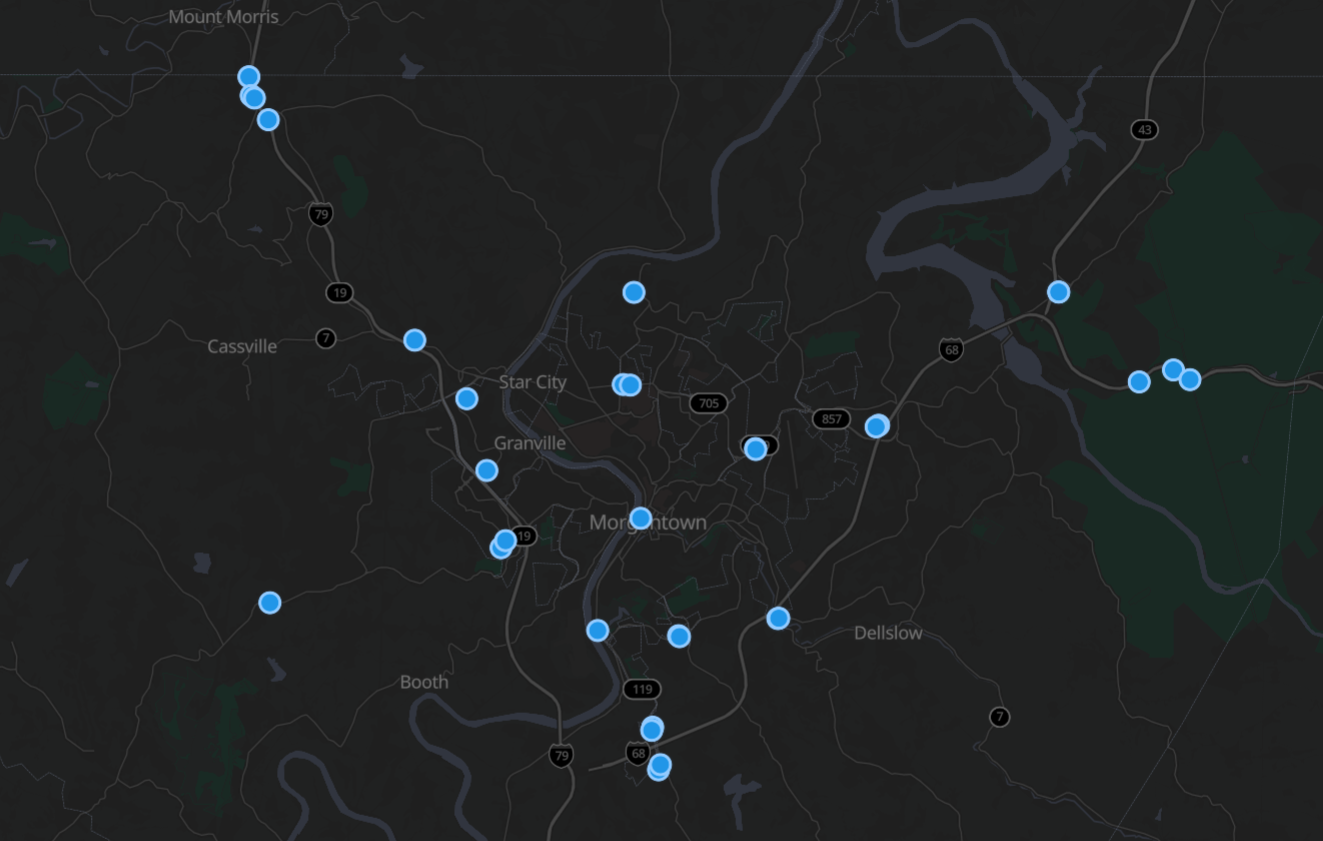
The Sheriff's Office runs 20 cameras.[2] The crowdsourced map below shows 33.[14]

Dark street map of Monongalia County with blue dots marking Flock camera locations in and around Morgantown, Star City, and Granville, and along routes 705, 19, and 857.
Crowdsourced camera locations from deflock.org, as of September 2026. Locations change; the live map has current data.[14]

How it got here

In November 2025, the Sheriff's Office asked the County Commission to buy 20 Flock cameras. The commission said yes, with opioid settlement money, outside the county's own grant process.[1]

  1. The pitch

    Sheriff's Office leadership and task force commanders present at a County Commission work session: 20 cameras, $193,000 for a three-year contract, discounted to about $180,000 if signed before November 14, when Flock would waive the installation fee. They cited examples of cases where the cameras "would have come in handy" and presented no evidence or statistics that they prevent opioid deaths or drug use.[1]

  2. The vote

    Seven days after the pitch, the Commission unanimously approves the three-year, $180,000 agreement, paid from the county's share of West Virginia's $980 million opioid settlement. The Sheriff's Office did not go through the county's formal opioid grant application process, the process other organizations must follow, with project summaries, justification documents, financial records, and six-month and year-end reporting. The Commission President confirmed: "Did they apply through the grant process? No."[1][17]

  3. First questions

    A WVU IT administrator warns the Commission about the system's defaults: data shared with law enforcement nationwide, a share of images kept by Flock to train its AI. He calls the surveillance "a massive overreach." Commissioners say they share some of his concerns. The Sheriff's Office says the cameras are headed for at least 10 undisclosed locations, with no placement timeline until after the new year. The deal is already signed.[18]

  4. Live, unannounced

    The cameras go live. The first evidence is the "success stories" dated April 2026 on the Sheriff's transparency portal. By mid-July the system had captured 525,370 images. The department had searched 101 of them. The other 525,269 were the movements of people suspected of nothing.[2][19]

  5. The pushback

    A petition to halt the program passes 1,400 signatures, and residents begin packing the commission's Wednesday meetings. The sheriff calls the criticism "scare tactics" meant to create a "mob mentality." The residents' numbers come from the ACLU: fewer than 1 percent of plates scanned are connected to any crime, and one in ten is misread. At a July press presentation the county reveals data retention has been cut from the 30-day "base package" described at approval to 21 days, after a federal appeals court ruling.[20][19]

  6. The records gap

    When 12 News filed a public records request for the documents the Sheriff's Office submitted to obtain the funding, the department said it had "no responsive records maintained."[1] Flock is now an election issue: the candidate who defeated an incumbent commissioner in the primary opposes the cameras, and a state senator from Monongalia is drafting a warrant requirement for the 2027 legislative session.[21][22]

Read the full timeline

Claims vs. reality

Flock's transparency portal for Monongalia County makes specific promises. The fine print is where they fall apart.

The claim
"Data is owned by Monongalia WV County SO and is never sold to 3rd parties."
The reality

Flock's Terms and Conditions split the data in two. "Customer Data" (the raw images) belongs to the county. But the analysis of those images is "Flock Property": Flock's terms define that to include "any derivative works, intermediate or final outputs, analyses, reports, models, or other results generated by or through the Flock Services," and grant the county "no rights... to download, extract, export, or otherwise create or retain copies" of it. The never-sold promise covers only Customer Data. And the county hands Flock an "irrevocable, perpetual, worldwide license" to use the raw data to "support and improve Flock's products and services." The county owns the raw images. Flock owns everything they become.[2][3]

The claim
"Contract Between FLOCK and Monongalia Sheriff's Office."
The reality

The "contract" published on the transparency portal is a purchase order. Flock's Terms and Conditions (which define themselves, together with the order form, as the entire "Agreement") live on Flock's website, where they were last updated August 21, 2026. Flock can revise them at any time. The county's real contract is whatever Flock's website says today.[3][4]

The claim
"What's Detected: License Plates, Vehicles."
The reality

The cameras photograph everything in frame and upload it to Flock's cloud, where the analysis extracts far more than plates. Flock sells a search tool called FreeForm that lets users query that imagery in plain language. Its own product page invites searches for "clothing, visible accessories, vehicle type, color, or damage." Published audit logs show the system has a "people" object class, with real searches like "Person wearing bright yellow," "man wearing a red hat and blue shirt," and "gray hoodie." Other reporting found searches for tattoos and race. Whether the Sheriff's Office has FreeForm enabled is beside the point: the county's images live in Flock's national database, where that capability exists whether we have access to it or not.[2][7][8][9]

The claim
"All system access requires a valid reason and is stored indefinitely."
The reality

In audit logs obtained across the country, officers' "valid reasons" include "LOL," "LMAO," "idk," more than 6,300 searches marked "TBD" across 30+ agencies, and keyboard mash ("asdfg," "lkjhg"). Nothing like this has surfaced in Monongalia County's audit log yet. It doesn't matter: officers from outside the county can search against our records too.[2][5]

The claim
"Prohibited Uses: Immigration enforcement, traffic enforcement, harassment or intimidation..."
The reality

The prohibition is a policy promise, not a technical control. Nationally, a DEA agent used a local officer's password, without the officer's knowledge, to search Flock for someone suspected of an "immigration violation." ICE and DHS access to the network is documented. And per the terms above, the policy that governs the system is Flock's website, which Flock can change at any time.[3][10]

The claim
"Data retention: 21 days."
The reality

The 21-day retention period governs how long Flock stores the county's footage and its metadata. It does not govern Flock Property, the analyses and outputs the county has no rights to. The terms also say Flock "will not be required to delete any data which it is obligated to retain pursuant to an applicable legal obligation or policy," such as audit logs and evidentiary metadata.[2][3]

The national pattern

The guardrails Monongalia County relies on are the same ones that failed everywhere else.

  • The Institute for Justice has cataloged 241 documented incidents of ALPR abuse: officers stalking romantic partners, wrongful stops at gunpoint, and searches of people who committed no crime.[6]
  • A Texas deputy used 83,000 Flock cameras to find a woman who allegedly had a medication abortion, at the request of her abusive partner. A Georgia police chief used the system to track his ex-girlfriend and her teenage daughter roughly 600 times. A Lufkin, Texas officer was indicted on 100 felony counts after searching for his ex-girlfriend more than 10,000 times.[6]
  • EFF's analysis of millions of audit records found officers searching the database for school residency checks, noise complaints, and background checks, with "LMAO" entered as the reason.[5]
  • Flock itself created a fake police department ("Flock City PD") and used it to search live cameras in U.S. cities for "crowds," people holding signs, and people wearing masks, during product demonstrations.[11]
  • Scores of towns have canceled or suspended their Flock contracts under public pressure. Flock's 2026 "reforms" (shorter default retention, offense filtering) are company policy. As EFF put it: "what is stopping Flock from reversing course on them...? Nothing."[12]

Take action

Other communities have gotten Flock contracts canceled. Ours can too.

Contact the County Commission

The commission approved this program and can end it. Monongalia County Commission, 243 High St, Morgantown, WV 26505. (304) 291-7257. Meeting schedule and agendas at monongaliacounty.gov.[16]

Contact the Sheriff's Office

Monongalia County Sheriff's Office, 116 Walnut Street, Morgantown, WV 26505. (304) 291-7260. info@monongaliasheriff.gov.[4]

Speak at a commission meeting

Public comment is how other communities moved their councils to act. Meetings are every Wednesday at 10am at the county courthouse.[16]

File a public records request

West Virginia's Freedom of Information Act lets you ask any public body for records: the search audit logs, the order form, the policies. The portal already publishes a monthly search audit. Ask for the history behind it.[2]

Use the ACLU's toolkit

The ACLU's Get the Flock Out toolkit includes model state and local legislation, a model contract-cancellation resolution, and a sample email to send your representatives.[13]

See the map, find others

deflock.org maintains a crowdsourced map of ALPR camera locations and a directory of local groups fighting them.[14]

Check your plate, with a caveat

haveibeenflocked.com lets you search released audit logs for your plate. Its own maintainers warn the dataset is incomplete: a clean result does not mean you haven't been surveilled.[15]

Sources

  1. WBOY 12 News (Hannah Heiskell), "Sheriff's office did not use Mon County's formal opioid grant process for Flock, commission says," Sept 18, 2026. wboy.com
  2. Flock Safety Transparency Portal, Monongalia WV County SO (accessed Sept 20, 2026). transparency.flocksafety.com
  3. Flock Safety, Terms and Conditions (last updated Aug 21, 2026). flocksafety.com/legal/terms-and-conditions
  4. Monongalia County Sheriff's Office, Flock Safety Transparency. monongaliasheriff.gov
  5. Electronic Frontier Foundation (Rindala Alajaji and Dave Maass), "The High Crime of 'LMAO': How Cops Are Treating Flock's Mass Surveillance As a Joke," Sept 14, 2026. eff.org
  6. Institute for Justice, The IJ Database of ALPR Abuse. ij.org
  7. Flock Safety, FreeForm product page. flocksafety.com/products/freeform-search
  8. Have I Been Flocked, FreeForm Report. haveibeenflocked.com
  9. 404 Media, "How Cops Use Flock to Track People, Not Cars," July 16, 2026. 404media.co
  10. 404 Media, "Feds Used Local Cop's Password to Do Immigration Surveillance With Flock Cameras," Aug 12, 2025. 404media.co
  11. 404 Media, "'Flock City PD': The Fake Flock-Owned 'Police Department' That Searched Real Cameras for Real People," Sept 17, 2026. 404media.co
  12. Electronic Frontier Foundation (Matthew Guariglia), "Too Little, Too Late: Flock Admits Their Technology Needs Reforms," Aug 13, 2026. eff.org
  13. American Civil Liberties Union, Get the Flock Out Toolkit. aclu.org
  14. Deflock. deflock.org
  15. Have I Been Flocked. haveibeenflocked.com
  16. Monongalia County Commission. monongaliacounty.gov
  17. The Dominion Post, "Commission approves funding for 20 license plate recognition cameras," Nov 12, 2025. dominionpost.com
  18. The Dominion Post, "Commission fields questions on Flock license plate reader cameras," Dec 10, 2025. dominionpost.com
  19. WV News (Chase Hughart), "Flock Safety cameras spark debate over privacy, policing in Monongalia County," July 17, 2026. wvnews.com
  20. The Dominion Post (Ben Conley), "Sheriff, county commission defend implementation of Flock cameras," July 1, 2026. dominionpost.com
  21. The Dominion Post (Ben Conley), "Commission candidates offer thoughts on Flock," Sept 18, 2026. dominionpost.com
  22. WV News (Charles Young), "WV Sen. Mike Oliverio calls for warrant requirement, other restrictions on Flock cameras in West Virginia," Sept 18, 2026. wvnews.com